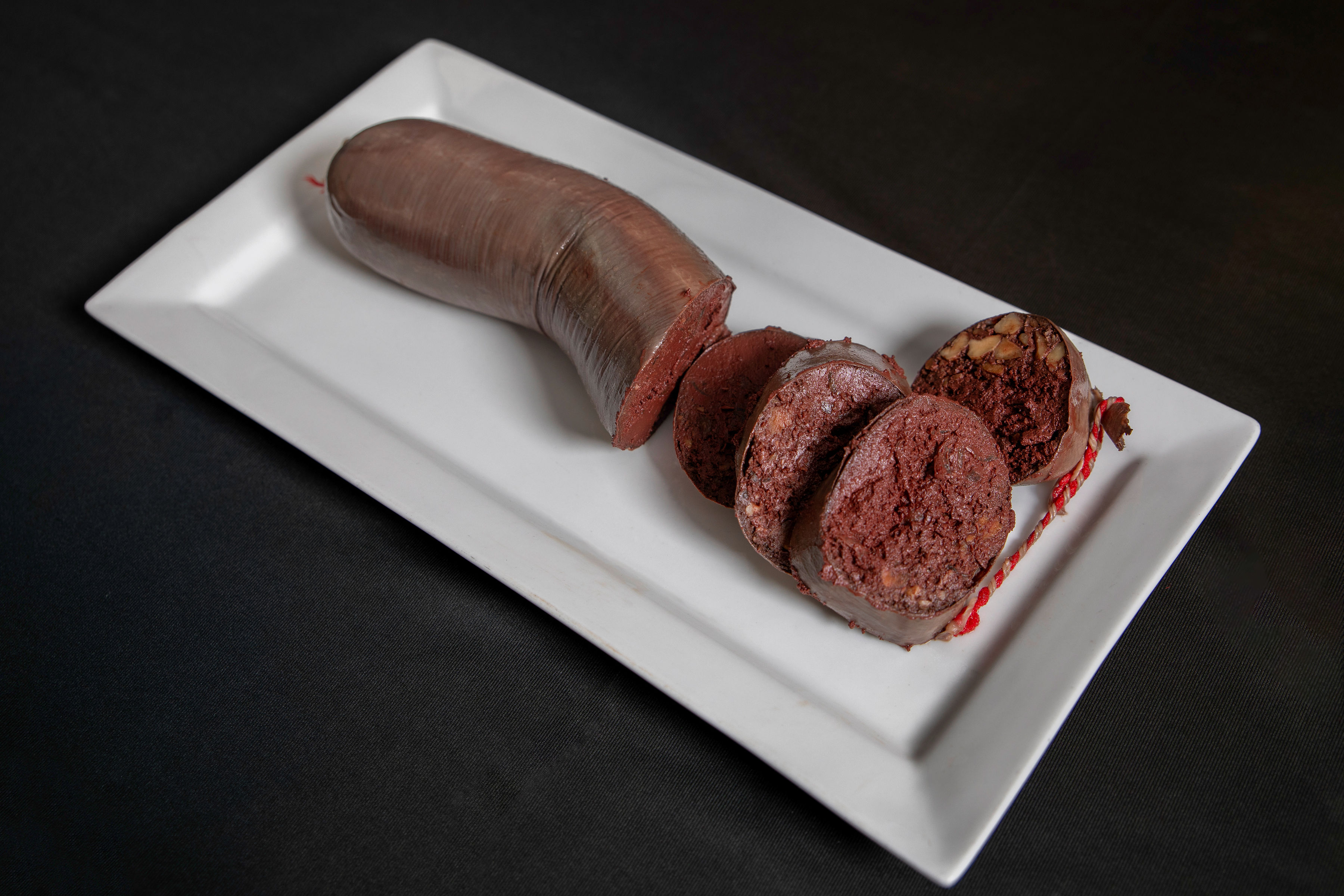
Mazzit was historically identified as one of the principal sources of protein for the Maltese population, with early twentieth century sources pointing out that it used to be eaten, in particular, but not exclusively on weekends and festivities, as well as to celebrate the end of fasting from meat following the Lenten period.
As with most traditional products, mazzit enjoyed a degree of seasonality. Blood is of course a highly perishable food, with bacteria multiplying rapidly if not chilled. The origins of mazzit during a historical period when fridges or chillers did not exist meant that the raw blood had to be processed quickly following collection, and avoiding hot summer months, when the perishability of blood was much more rapid, and therefore mazzit could become a health-risk. Such a tradition continued till the present day notwithstanding the introduction of mechanical chilling equipment with the use of un-chilled blood for the production of mazzit within a period of between two-and four hours being retained.
The earliest known reference to mazzit dates back to the mid-18th century, mentioned in Gian Francesco Agius De Soldanis’ work from 1750 – Damma tal kliem kartaginis mscerred fel fom tal Maltin u Ghaucin. Subsequent references can be found in Mikiel Anton Vassalli’s Ktŷb yl klŷm Mâlti, ‘mfysser byl-Latîn u byt-Taljân (1796). However, the word mazzit itself seems to have Greek origin given its phonetic similarity to the Byzantine blood pudding aimatia.
Dictionaries, recipe books, and historical accounts highlight the cultural, nutritional, and social significance of mazzit for the Maltese population. It is of course best remembered for the proverb fl-aħħar tal-mazzita issib iż-żbiba, showing its enduring cultural significance.
The basic ingredient of mazzit represents a conscious decision of a historical rural society to choose blood from livestock whose blood was the likeliest to be suitable to consume. This source is still the only blood accepted in view of the ingrained organoleptic properties of the final product – pig blood signifies the sweeter option. The pig or male bovine blood, as well as the intestines, are sourced hygienically at an approved abattoir. In particular, the blood has to be sourced at room temperature, without any additional additives but manually or mechanically stirred to remove the fibrin to avoid coagulation. The Maltese onions are bought by the producers themselves, either directly from the farmers who grow them, or from the Pitkalija Market. Mazzit was (and still is) produced all over the Maltese islands; with a particular concentration of producers in the south-west of Malta – a sub-region which was relatively close to a number of slaughterhouses including the Public Abattoir which has been operational in Malta since 1897. It is an area which is also contiguous with the Siġġiewi-Fawwara area which was well known for the production of Maltese white onions.
Of significance is the fact that measurements are defined in approximate terms, fuq l-għajnejn [lit: by sight] and refers to the quantities ‘internalized as second nature’, transferred from generation to generation through experience and socialization. Indeed, old Maltese recipe books tend not to spell out quantities of most of the ingredients, assuming that they are known to the reader by way of such shared knowledge.
Notably, weights and dimensions of the product reflect the traditional Maltese weights, which have medieval origins and this notwithstanding that historically Malta formally moved towards the British imperial system in the nineteenth century, and the metric system in the second half of the twentieth century. Thus a mazzita weighs one ratal (c. 0.8kg) with the margin of tolerance being defined in terms of kwart ta’ ratal (c. 0.2Kg). It is traditionally consumed in slices circa pulzier (one Maltese inch) thick. Even the percentages of the main ingredients refer to approximations of such measurements with blood being circa half of the total (or nofs artal) whilst the onions and raisins being circa one-fourth (kwart ta’ ratal).